The Evangelist Luke – Physician, Iconographer, and Companion of the Apostle Paul
On 18 October, our Church commemorates the Holy Evangelist Luke.
One quarter of the New Testament comes from the pen of Paul’s personal physician, an “ascetic” of holistic healing of both soul and body. In Christianity, Luke discovered a new therapeutic “treatment,” one intended for communities, unknown to the two great healing centres of the Mediterranean—the sanctuaries of Pergamum and Epidaurus.
It is worth noting that most Greeks are unfamiliar with the true identity of Epidaurus, whose original character has, for decades, been painstakingly reconstructed by Professor Vassilis Lambrinoudakis: The Asclepieion of Epidaurus: A Place of Care for Body and Soul (or, more precisely, for the “Nous”).
Luke, the only “Greek” (that is, non-Jewish) author of the New Testament, is also the only Evangelist who—apart from, perhaps, Paul and Apollos—possessed a formal scientific education as a physician. It is noteworthy, however, that names ending in -as were commonly borne by slaves.
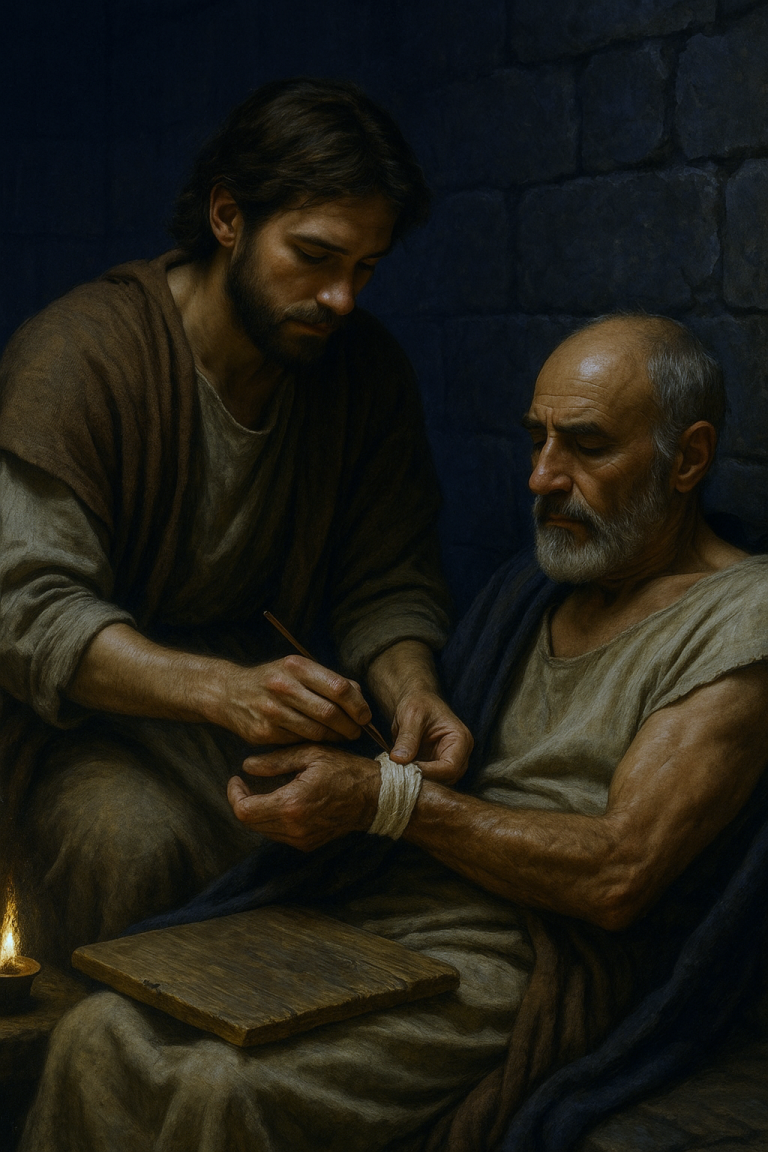
He is called “the beloved” by the Apostle to the Nations and was ultimately the only one who remained at Paul’s side to tend his wounds—the “marks” with which the Apostle’s body was covered—for the greatest “miracles” are, in truth, wounds.
It is indeed striking that, although we live in an age of spectacle and fear—an age in which we are anxious, among other things, about the upheavals that Artificial Intelligence promises to bring to every sphere of life—we know so little, despite the abundance of information surrounding us, about the holistic “therapy” that certain personalities demonstrably experienced in both soul and body, and recorded with “surgical precision” as plerophoria—full assurance, a state of true fullness.
Indeed, “the salvation of the soul”—that is, of the whole human person—is a great thing, like a journey of renewal and refreshment (anapsychē), a journey of discovering true Beauty and Joy, both of which are inseparably linked to salvation itself—to becoming truly whole.
Some “Surprises” about Luke and His Work that Challenge Long-Held Assumptions
Luke (Lucas), unlike the names Lucianus or Lucius, is not etymologically derived from lux (“light”). Rather, it means “one who comes from Lucania” (or Leucania), on the western coast of southern Italy. Yet his writings recount captivating stories of the passage from darkness into light, such as the revelation of the Risen Christ to the two “unknown” disciples who, utterly disillusioned, were making their way in the gentle springtime down to Emmaus (“healing springs”), or His revelation to Saul on the road to Damascus, descending from the Golan Heights and Mount Hermon, where the three disciples most probably also witnessed the Lord’s Transfiguration.
According to ancient tradition, Luke came from Antioch in Syria, today largely devastated by earthquakes, the second great metropolis of Christianity after Jerusalem. Yet, through the celebrated “we” passages of his writings—in which he includes himself as an eyewitness—he is especially connected with Troas and with Philippi, the “little Rome” (modern Christoupolis, or Kavala), where he ought to be particularly honoured. Holzner observes that Luke’s remarkable knowledge of seafaring suggests either that he was born in a port city or that he travelled extensively, as Greek physicians commonly did. He further proposes that Luke originally practised medicine in port cities such as Troas. Recent examinations of the holy relics of St Luke, preserved in the Basilica of Santa Giustina in Padua, Italy, have confirmed that, like the Myrrh-bearing Women, he remained active until an advanced age, “with both his soul and his feet.”
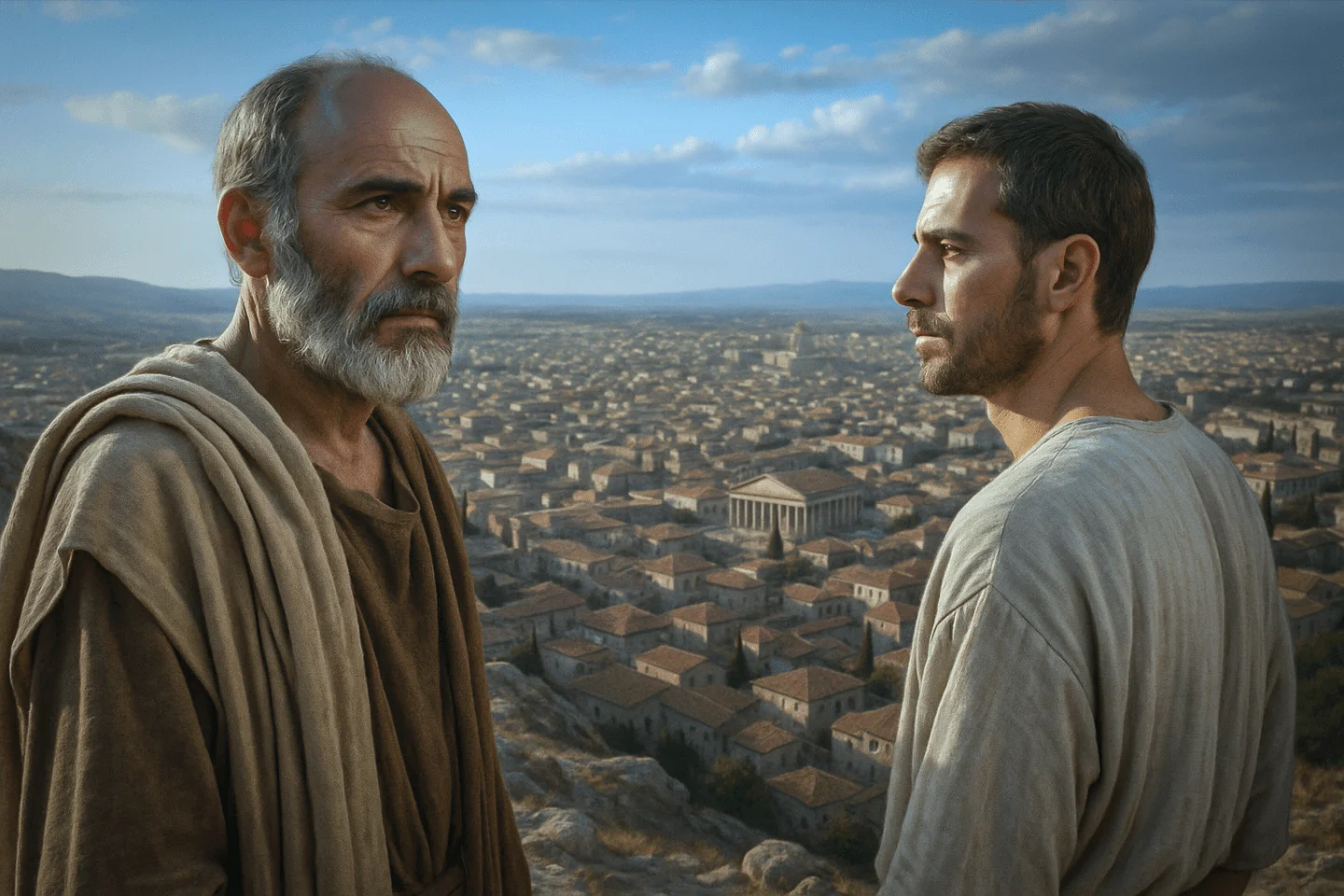
Luke is also connected with southern Greece (“Achaia”), since, according to ancient tradition, he reposed at an advanced age in Boeotia, the homeland and field of activity of the renowned first-century philosopher Plutarch, who sought to bridge philosophy and religion, as well as Athens and Rome. In the same region where the priest at nearby Delphi—the “navel of the Greek earth” and the seat of the famous Pythian oracle mentioned in the Acts of the Apostles—would compose his Lives and Moralia, Luke (who has not yet received the appreciation he deserves from scholars of Philology and Philosophy) wrote his own narrative, presenting the new ethos of Christianity as a therapeutic community whose purpose is to cast out Satan. He likewise unites Athens, where he portrays Paul speaking like Socrates, the “witness to the truth,” with Jerusalem and its Scriptures, and with Rome—where Augustus, “Theophilus,” and even the open ending of the book all play their part—while the Christianity he presents as “the Way” also bears a distinctly philosophical dimension.
The two of the twenty-seven books of the New Testament attributed to Luke, probably written in southern Greece as mentioned above—the Gospel according to Luke and the Acts of the Apostles—constitute between one quarter and one third of the entire New Testament. They are exceptionally extensive works, each occupying the maximum length of a single scroll, amounting together to fifty-two chapters. Naturally, neither the titles of these books nor their later division into chapters and verses originated with the authors, who composed their texts to be heard in their entirety. The title Acts is itself somewhat problematic, for Luke’s concern is not primarily to exalt the “acts” (that is, miracles or displays) of all the Apostles, but rather to bear witness to the work of the Holy Spirit—the true power of the new Rome—manifested chiefly through the preaching and dialogue of two Apostles, Peter and Paul. It is possible, however, that the title Acts eventually became established in deliberate contrast to the Res Gestae (“Deeds”) of Augustus—his public record of spectacles, military campaigns, and achievements—which was displayed throughout the Empire as propaganda for the Roman Peace (Pax Romana). Some scholars have even suggested that Luke contributed to the magnificent Epistle to the Hebrews (whose Greek is among the finest in the Bible, comparable to that of Luke’s Gospel), and that he also played a creative role in the composition of the three Pastoral Epistles, the “swan song” of the Apostle to the Nations.
The tradition that Luke “depicted” — that is, painted — the icons of the Theotokos preserved at the Monasteries of the Great Cave (Mega Spilaion), Kykkos in Cyprus, and the Russian city of Vilna is considerably later in origin. It goes back to Theodore the Reader (Theodoros Anagnostes) around A.D. 530. It most likely arose from the fact that Luke is the only Evangelist who “paints through his writing” a Gospel of the humble and the despised, as exemplified by the trilogy of the Lost (the lost sheep, the lost coin, and the prodigal son) and the Parable of the Good Samaritan, in which the “dramatic triangle” is employed with remarkable literary skill.
Moreover, from his familiarity with the language of the Septuagint, we may infer that before embracing Christianity both Luke himself and the most excellent Theophilus, the recipient of his two-volume work, had spent many years “studying” in the Jewish synagogue and ḥavrāh (study fellowship).
It is regrettable that no complete Commentary on the Gospel according to Luke by John Chrysostom has survived. Yet Luke, as a true physician, examines the entire “case history” of his Protagonist—from the very moment of His conception, through the months of His gestation, and even His transition into adolescence at the age of twelve. At the same time, he gives special attention to what antiquity regarded as the crucial art of prognosis, by composing the Acts of the Apostles, in which the Gospel is brought to its fulfillment.
Likewise, in the hymnography of the Sundays of the Pentekostarion (the liturgical season following Pascha), during which Acts is read together with the Gospel according to John, this astonishing book is unfortunately never celebrated in the hymns. As a result, it remains, even today, largely unknown—just as it already was in the age of Chrysostom.
Luke himself makes clear, in the famous Prologue to his two-volume work, that he was not among the eyewitnesses of the Lord. Consequently, he cannot have been one of the two disciples walking to Emmaus (as Byzantine hymnography poetically suggests), nor did he belong, as the Synaxaria state, to the Seventy (or Seventy-Two) disciples—the wider circle of Jesus’ followers, whom Luke alone among the four Evangelists explicitly mentions.
What is truly remarkable is the extraordinary mastery with which this physician handles both language and style. He opens his work in elegant literary Greek, only then to adopt the idiom of the Translators—or rather, the Interpreters—of the Septuagint, produced in Alexandria, the cultural capital of the Mediterranean world. In this way he emphasizes the direct continuity between everything that had gone before in the Bible of the “despised” and “socially isolated” Jews—drawing especially upon the Books of Kingdoms (Samuel–Kings) and Chronicles—and the mighty works accomplished through the Incarnation of the Logos, as Jesus the Messiah is called in Luke’s Prologue, many years before John composed the majestic Prologue to his own Gospel.
He is equally masterful in his “direction,” for he “paints” in a beautiful diptych the Big Bang of the new Creation through two parallel and wondrous births: that of the Lord Jesus, born of the twelve-year-old Virgin Mariam, and that of John the Baptist, born to the aged and formerly barren Elizabeth.
Of course, since divine inspiration does not employ the human pen as a mere typewriter, although Luke promises to narrate everything with precision, certain historical “inaccuracies” already appear in his infancy narrative. The synchronization of the Messiah’s birth—which most likely occurred in the summer of 6–7 B.C., about two years before the death of Herod in 4 B.C.—with the census of Quirinius, which took place in A.D. 6 in connection with the revolt of Judas the Galilean, does not accord with the historical evidence available to us. Likewise, the placing of the revolt of Theudas before that of Judas (Acts 5:36–37; cf. Josephus, Antiquities 20.102, during the procuratorship of Fadus, A.D. 44–46) presents chronological difficulties.
By contrast, Luke proves remarkably accurate in his use of local official titles: the strategoi (“magistrates”) at Philippi (Acts 16:20), the politarchs at Thessalonica (Acts 17:6–8), and the proconsul Gallio at Corinth (Acts 18:12). Furthermore, although Luke was one of Paul’s most beloved companions, he appears to differ from him on certain questions concerning the Law (the Torah), such as the eating of meat sacrificed to idols. He preserves his own distinctive theological identity—something that is itself profoundly Christian—and one that also exercised a deep influence upon the Gospel according to John.
The Gospel according to Luke is the only one of the four Gospels that begins with a formal prologue addressed to a specific individual, indeed to one described as “most excellent” (kratiste), who apparently belonged to the Roman elite. Yet the name Theophilus (“lover of God” or “friend of God”) may refer not only to the patron—or sponsor—of the work, but also symbolically to every man and woman who loves God.
This introductory passage, composed in some of the finest Greek found anywhere in the Bible, has recently been shown to follow not so much the model of historical works as that of ancient medical treatises. Luke is also the only Evangelist who inaugurates his Protagonist’s public ministry with a magnificent programmatic address at Nazareth. And while his Jesus is born within the framework of Augustus’ first universal globalization, He will overturn its entire pyramid—not by violence, but rather through His own self-sacrifice.
Indeed, this physician deliberately leaves the ending of his two-volume work open—although he most likely composed it after the martyrdom of its second great protagonist, Paul—so that we, the readers, or rather the hearers of his narrative, may complete it with our own witness and, if need be, with our own martyrdom.
The tradition that Luke “recorded” or painted icons of the Theotokos in the monasteries of the Great Cave (Mega Spilaion), Kykkos in Cyprus, and in the Russian city of Vilna is rather late in origin: it goes back to Theodorus the Reader (Theodoros Anagnostes) around A.D. 530. It likely arises from the fact that Luke is the only Evangelist who “paints by writing,” composing a Gospel of the humble and the despised—such as the trilogy of the Lost (the lost sheep, the lost coin, and the prodigal son) and the Parable of the Good Samaritan—in which the “dramatic triangle” is skillfully employed.
Moreover, from his familiarity with the language of the Septuagint, we may infer that before being initiated into Christianity, both he and the most excellent Theophilus, the recipient of his two-volume work, had spent considerable time studying in the Jewish synagogue and ḥavrāh (study fellowship).
Whereas in Byzantine iconography the symbol of this Evangelist is the ox (a sacrificial symbol), in his two-volume work he himself uses as a “red thread” the Road—the Journey—the Voyage. The “Way” was the name of the earliest Christians, and it is on journeys that all the great revelations of life occur. These are then sealed with a shared meal and with magnificent hymns of thanksgiving (“Magnificat-like songs”), such as Mary’s Magnificat, which is not the voice of a “passive vessel” but of a vibrant protagonist of life, as are the other women of the “Memoirs” (as the Gospels were originally called): “My soul magnifies the Lord… He has cast down the mighty from their thrones.”
Asclepius was killed by the Father of gods and men because he raised the dead and exposed Hades. The God and Father of Luke, however, raises His beloved Son Himself in order to free humanity from the absolute pathological terror of death and to offer a complete “upgrade” to the human body and society.
Journey, meal, hymnography, and active listening to narration (storytelling) of the great deeds of the true Savior and Messiah—“the things that have been fulfilled among us”—within small communities marked by enthusiasm and communion (co-inclusion), are even today rediscovered as the greatest antidote to the autoimmune condition of our narcissism.
At the open ending of his two-volume work, Luke composes a new Odyssey, in which he and his Protagonist ultimately arrive, in the most unexpected way, at the “Eternal City.” In the end, our life is indeed read like Hebrew: from end to beginning, while we ourselves supply the vowels.
Jesus, the eschatological Prophet (Deut. 18:15), who is paralleled with Elijah and Elisha (cf. 4:25–27), is the Son of the Most High, Christ, Lord, and Savior, whose presence—unlike the “gospels” of every so-called world ruler or Caesar—brings authentic peace and joy (2:32–36; 10–11; Acts 2:36).
One image of the Church, according to Holzner, was painted by the hand of Paul in his letters, and the other by the calm and steady hand of the physician who handled both the scalpel and the pen with equal ease. The East and Greece offered their two greatest gifts: the depth and fiery vision of Paul’s prophetic insight, and the clarity and grace of Luke’s thought.
The six exorcisms and seventeen healings performed by Jesus—affecting both humanity and nature—reveal the glory of God, heal life as a whole, and teach the mysteries of the new polity (i.e., the Kingdom) of God. They presuppose, on the part of the human being, sensitivity and trust in God, in humanity, and in life. Moreover, the Evangelists never state that Jesus performed “miracles,” because a miracle is something that dazzles the human being, suppresses their freedom, and ultimately forces them to believe in the one who performs it. Instead, the Evangelists speak of “portents” and “powers,” while John uses the term “signs”—signs of the Kingdom, of the presence HERE and NOW of God’s new world.
Excerpt from the book Holy Gospels, published by Ennoia Editions, by Professor Sotirios Despotis. (translated from Greek)