The Apostle Thomas in India
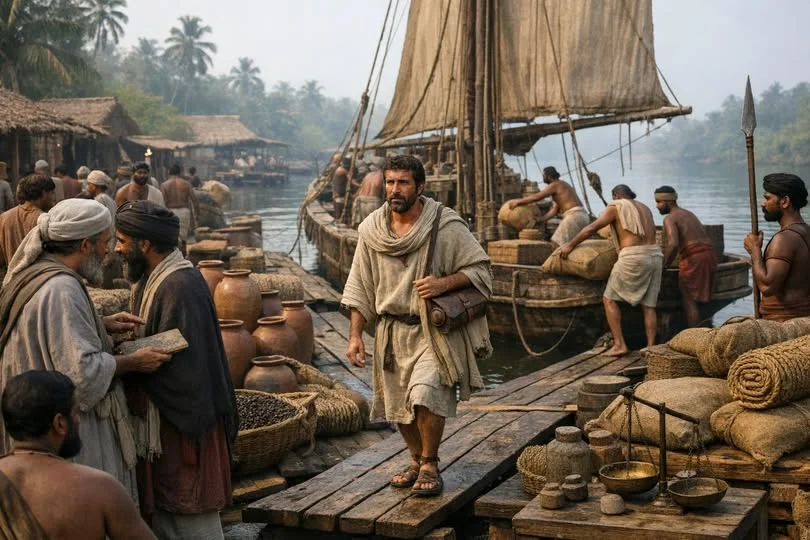
According to ecclesiastical tradition, the Apostle Thomas arrived in the region of present-day Kerala, India, around 52 AD. It is thought that he disembarked at the ancient port of Muziris, whose location is today identified with Pattanam. At that time there was in the area a thriving community of Jewish merchants (the so-called Cochin Jews), which could explain Thomas’s journey from Syria via merchants’ caravans.
The earliest known written source linking the Apostle Thomas with India is the Acts of Thomas (Acta Thomae), an apocryphal work dated to the early 3rd century AD, probably written in Edessa in Syria. The work was written in Syriac, while the Greek translation circulated somewhat later, probably in the 3rd or early 4th century. It belongs to the broader corpus of Christian apocryphal Acts of the Apostles (such as those of Peter, Paul, and Andrew). It does not stem from the Manichaean tradition, as was once thought, but it contains Gnostic influences and allegorical theological interpretations that do not coincide with the Church’s official apostolic teaching.
Although the text has a strongly symbolic and theological character—blending historical elements with allegorical narratives—it is considered valuable for the study of the early tradition connecting Thomas with India. It describes the Apostle’s meeting with King Gondophares, the founding of communities, and his martyrdom in eastern India. While the details cannot be historically verified, its references to commercial and geographical features of India—such as ports and local kingdoms—accord with known data from the period, which lends a certain degree of historical credibility regarding the existence of early contacts between Syria and the Indian South.
Thus, although the Acts of Thomas cannot be treated as a historical chronicle, they constitute an important testimony to the very ancient belief that the Apostle Thomas worked in India and was martyred there, later forming the foundation of the tradition preserved by the Christians of Kerala.
The tradition of the Apostle Thomas’s journey to India is not limited to the apocryphal Acts of Thomas, but is also supported by references from ecclesiastical writers of the early centuries. In the 3rd and 4th centuries, several Church Fathers mention Thomas’s activity in the “Indies.” Ambrose of Milan, Gregory the Theologian, Jerome, and Ephrem the Syrian affirm the tradition that Thomas went to the distant East, where he preached the Gospel and was martyred for the faith.
In parallel, Eusebius of Caesarea (4th c.), in his Ecclesiastical History, reports that Pantaenus, the teacher of Clement of Alexandria, traveled in the 2nd century AD to India, where he found an already established Christian community that used the Gospel of Matthew “in the Hebrew language.” This reference, though geographically unclear (since the term “India” was then used for various eastern regions east of Persia and Arabia), strengthens the tradition that the beginnings of Indian Christianity are rooted in apostolic times.
According to the tradition of the Christians of Kerala, as recorded in the Songs of Thomas (Thomma Parvam), the Apostle Thomas founded seven churches in the region of Maliankara on the coasts of present-day Kerala. The narrative speaks of the conversion to faith in Christ of Jews, local inhabitants of the area, and even the local ruler in Kodungallur (Cranganore). After his work on the western coast, Thomas is said to have traveled to eastern India, where he was ultimately martyred near present-day Chennai (Madras), at a place later known as Mylapore. There, according to the same tradition, he was buried.
The Apostle Thomas converted certain Hindu families to Christianity, including Brahmins. Local narratives of the Christian community of Kerala specifically mention the number of 32 Brahmin families that accepted the new faith. The tradition of the Saint Thomas Christians (Nasrani) maintains that the clergy came mainly from two families, the Shankarapuri and Palamattam, within which the priesthood was preserved hereditarily for many centuries, following the patterns of the Syriac Church of the East. At the same time, historical testimonies show that members of this community adopted certain Hindu social practices and clothing customs of the Brahmins, combining local culture with their Christian identity.
The transfer of the Apostle’s relics to Edessa in Syria is a particularly important chapter in the development of his veneration. According to ancient sources, such as Ephrem the Syrian’s Discourse on the Divine Men and the testimony of Eusebius of Caesarea, his relic was brought to Edessa by merchants or members of the local Church already by the 3rd century AD, probably around 230–240 AD. This translation contributed to Edessa becoming a center of devotion to Saint Thomas, hosting a Martyrium and a Basilica in his honor. In the following centuries, his reputation as protector of Eastern Christians spread throughout Syria, Mesopotamia, and Persia. During the Crusades, part of the relics is said to have been transferred to Ortona in Italy in the 13th century, where his memory continues to be honored.
According to tradition, several centuries after the martyrdom of the Apostle Thomas, a group of Christians from Mesopotamia arrived in Kerala under the leadership of the merchant Thomas of Cana (Knai Thoma). Sources in local ecclesiastical tradition differ regarding the dating of this event—some place the arrival around 345 AD, while others later, up to the 8th century. The epithet “of Cana” is probably due to a misunderstanding of the Syriac word Kna’i, meaning “merchant” or “man of Cana”; thus Thomas Knai is considered to have been a Syriac–Mesopotamian merchant who led Christian settlers belonging to the Syriac Church of the East, later associated with the theological current of Nestorianism.
According to epigraphic and traditional testimonies, Thomas of Cana received commercial and self-governing privileges from the local Indian ruler and settled his community in southern Kerala. These Christians were called the Knanaya or “Southerners,” while the pre-existing communities—who maintained the tradition of the Apostle Thomas’s coming—were called Northerners or “of Saint Thomas.” Gradually, these two groups coexisted, maintaining distinct identities but sharing the same Syriac liturgical tradition. The arrival of Thomas of Cana is considered crucial because it revitalized the older Christian communities of Kerala and linked them more systematically with the organized hierarchical network of the Church of the East in Mesopotamia, contributing to the strengthening of their ties with the broader Syriac Christian world.
In 1523, Portuguese missionaries built a magnificent church at the site where, according to tradition, the tomb of the Apostle Thomas was located (Chennai, India).
Metropolitan of the Eastern Orthodox Metropolis of Hong Kong and Southeast Asia, Nektarios