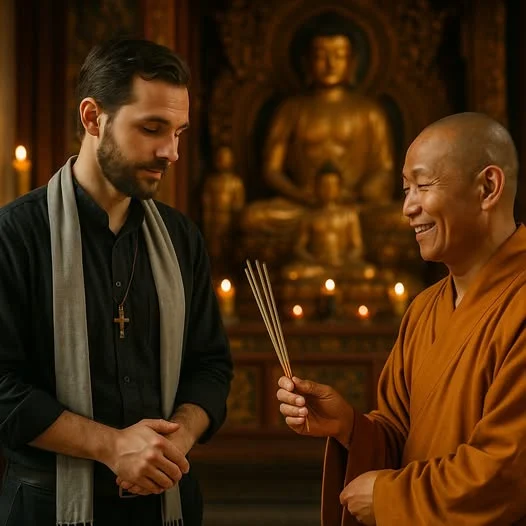
The Witness of Faith in the Age of Tourism: What St. Barlaam the Martyr Teaches Us
The memory of Saint Barlaam the Martyr of Caesarea reminds us in a deeply moving way of the power of confession and the gravity of every act related to the worship of the true God. The Saint stood unwavering before the altar of idols, holding burning coals in his right hand, choosing to be consumed by fire rather than appear—even in the slightest degree—to offer incense to idols. His act remains an eternal example of faith and discernment, one that retains its relevance even today, especially for Orthodox Christians who live or travel in the Far East.
Whether residing for work or visiting countries with ancient religious traditions—such as India, China, Japan, or Thailand—many Christians find themselves, often without realizing it, involved in practices that are not mere cultural expressions but are essentially religious acts: the lighting of incense in Hindu, Buddhist, or Taoist temples; placing small offerings before statues of deities; or taking part in lantern ceremonies on rivers or the sea in honor of ancestors, spirits, or gods. These gestures, however innocent or “touristic” they may seem, are in truth religious in nature.
The Church has always taught that prayer and worship belong to the one true God alone. The early Christians, even during the times of persecution, understood that even the slightest appearance of participating in pagan rites amounted to a denial of faith. This is why the Martyrologies are filled with accounts like that of Saint Barlaam, who refused to compromise even momentarily the integrity of his confession. Such spiritual sensitivity is not “fanaticism,” but a profound theological awareness—the understanding that every act of worship expresses faith and reference to a particular divinity.
In our time, familiarity with other cultures, the desire for peaceful coexistence, and respect for what is different are indeed virtues. Nevertheless, courtesy and respect for the beliefs of others must not lead to confusion of spiritual boundaries. Orthodoxy is not merely a cultural system but life in Christ. A believer visiting a Buddhist temple should show politeness and respect without, however, betraying his or her faith. Even a seemingly simple gesture—such as bowing, lighting incense, or placing an offering—is not without significance, for it expresses participation in worship that is not directed to the true God.
Pastoral experience shows that catechesis and spiritual awakening are greatly needed in such matters. Many faithful, through ignorance or lack of discernment, may be drawn into these actions without any intention of denying their faith. Here lies the duty of the Church: to enlighten, to explain, and to guide with discernment and love. True witness to the faith does not require aggression or contempt for others, but steadfastness in the truth that sets us free.
Thus, Saint Barlaam becomes a spiritual guide for every Christian who lives among other religions and cultures. His confession is not confined to the past; it is a reminder to remain alert, discerning, and steadfast in bearing true witness without compromise. The Lord calls us to love all people, to show respect to everyone, but to worship Him alone. In our globalized age of travel and cultural exchange, the world needs Christians who understand what faith means and how to confess it with love and devotion.
Metropolitan Nektarios Tsilis of Hong Kong